

Bio-based textile finishes: from plants to performance
For decades, the textile industry has relied on petroleum-based finishes to provide fabrics with...
For decades, the textile industry has relied on petroleum-derived finishes to provide fabrics with key properties such as water repellency, resistance to stains, finishes or protective coatings. These products have allowed great advances in functionality, but have also generated a strong dependence on fossil resources.
The problem is increasingly evident: the environmental impact of conventional finishes – from CO₂ emissions to persistent waste – has put substances such as PFAS, organic solvents or certain petrochemical polymers. Added to this is growing regulatory pressure and greater social awareness that demands safer and more sustainable solutions.
In this context, a real opportunity arises: bio-based finishes, formulated from polymers and resins of natural origin such as starch, modified cellulose or vegetable oils. These compounds allow technical performance to be maintained, but with a much smaller environmental footprint, paving the way towards a new paradigm in textile chemistry.
What are bio-based finishes?
Bio-based finishes are textile treatments developed from raw materials of biological origin – such as starch, cellulose, vegetable oils or natural proteins – instead of fossil resources. Unlike traditional synthetic finishes, which are mainly derived from petroleum, bio-based finishes are characterized by their renewability, lower environmental footprint and, in many cases, biodegradability.
Main sources:
-
Starch and derivatives: used as a sizing agent or thickener in coating formulations, it can be chemically modified to improve its resistance to water and corrosion. abrasion.
-
Modified cellulose: applied in hydrophilic coatings and finishes, improves dimensional stability and provides touch pleasant.
-
Vegetable oils (castor, soy or flax): through polymerization or epoxidation processes, they become resins suitable for coatings and repellents. This is one of the most active lines of research in sustainable coatings.
-
Natural proteins (casein, keratin, sericin): used as sizing agents or in functional finishes, they provide properties such as softness, shine or even bioactivity.
Types of chemicals that can replace:
-
Sizing: derivatives of modified starch replacing synthetic sizing. Seen in industrial uses of polysaccharides in PET collars to facilitate the had.
-
Coatings and coatings: polymerized vegetable oils serve as a base for coatings without the need for petroleum-derived resins.
-
Repellents and additional functionality: PFAS alternatives with natural extracts (such as water chestnut) that offer antioxidant protection and some durability.
-
Recent research in Fashion and Textiles: application of chestnut shell extract with properties antioxidants.
Overall, bio-based finishes not only seek to match the technical performance of synthetic finishes, but also respond to increasing regulatory pressure and demand for safe and environmentally friendly solutions.
Examples of current applications
1. Sizing and sizing based on starch and polysaccharides
Sizing agents are being developed from raw starch with high biodegradability, improving fabric performance, abrasion resistance and reducing costs. Recent experiments show that these formulations reduce viscosity and are more energy efficient, with easily degradable wastewater (BOD₅/COD ratio ≈0.65) and up to 61% cost savings compared to conventional formulations — in addition to increasing loom efficiency by between 5 and 12%.
2. Bio-based coatings and membranes (epoxidized vegetable oils, green polyurethanes)
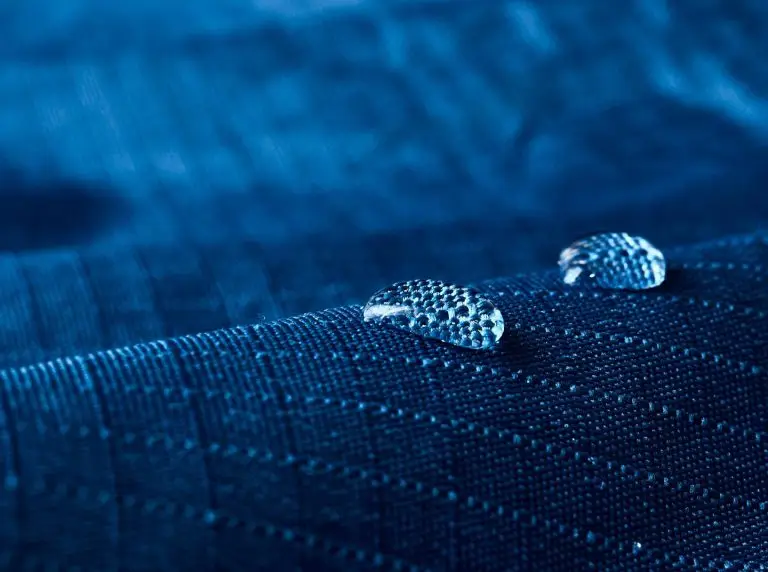
Epoxidized vegetable oils (such as cottonseed oil) are used as a green alternative to formaldehyde-based resins to provide water repellency and wrinkle resistance. A water contact angle of up to 125° has been observed, demonstrating a strong repellency.
Additionally, vegetable oil-based polyurethane dispersants, produced from renewable resources, enable sustainable coatings with improved mechanical properties and potential. antibacterial.
3. Water repellents from natural wax or hybrid formulations
Water-repellent finishes have been developed using emulsions of natural waxes, such as beeswax, carnauba or certified vegetable mixtures, which maintain the permeability and natural feel of the fabrics. For example, the products OrganoTex Wash-In and Spray-On are formulated without PFAS or synthetic polymers; They are 100% bio-based, biodegradable and eco-labeled, complying with OEKO-TEX ECO PASSPORT and USDA Biobased standards 100%.
An ecological coating based on carnauba wax on cellulose fibers has also been tested, maintaining the breathability intact.
These applications illustrate how bio-based chemistry is gaining ground in textile finishing: from functional finishes to coatings or repellents, there is a real sustainable option that maintains technical performance.
Benefits and challenges
Benefits
-
Reduction of emissions and dependence on oil. The materials bio-based They are obtained from renewable biomass, which helps reduce the use of fossil fuels and, therefore, the carbon footprint of the sector textile (less emissions in its life cycle).
-
Renewability and biodegradability. They are materials that are largely biodegradable and of renewable origin, especially compared to synthetic ones derived from oil.
-
Alignment with sustainable regulations and expectations. They respond to growing demand regulatory and the consumer towards more materials clean and circular.
Challenges
-
Costs and scalability. He cost of obtaining bio-based raw materials and the need to adapt existing infrastructures make rapid large-scale adoption difficult.
-
Stability and performance compared to synthetics. These materials often offer minor durability, stability in wet conditions or mechanical resistance compared to synthetics conventional.
-
Production at scale and technical feasibility. Achieving efficient high-volume production requires overcoming limitations technological and logistical.
Recent cases and innovations (non-ADRASA commercial)
1) Startups and research centers that work with biopolymers for textiles
-
Spinnova (Finland):develops a cellulosic fiber from wood pulp or waste (textiles, agricultural, leather), without aggressive chemical dissolution processes; Its route is mechanical and low chemistry, aimed at reducing impacts compared to conventional regenerated fibers.
-
DITF Denkendorf (Germany): investigate coatings bio-based; for example, a lignin-based protective layer that extends the life of geotextiles of natural fibers, maintaining functionality in humid/buried conditions.
-
VTT (Finland) and BioFibreLoop consortium (EU):initiative for circular technical textiles made with biopolymers (lignin, cellulose, PLA) and bioinspired functionalization; foresees maturity technological high in the coming years for outdoor and workwear.
2) Examples of use in sustainable fashion and technical textiles
-
Bananatex® (QWSTION):biodegradable and plastic-free technical fabric, made with abaca fiber grown in agroforestry systems; It accepts natural waxes for waterproofing, and is used in accessories and functional fashion.
-
AMSilk – biotechnological “silk” type fibers:its Biosteel® fiber (protein, produced by bioprocess) was used in the prototype adidas Futurecraft Biofabric as a demonstration of high-performance bio-based materials.
-
Bio-based / PFAS-free water-repellent finishes
-
OrganoTex:100% biobased, biodegradable and PFAS-free waterproofing treatments, with ECO PASSPORT (OEKO-TEX) and USDA Certified Biobased Product; designed to restore repellency while maintaining breathability.
-
HeiQ Eco Dry™: family of PFC-free DWR technologies, aimed at durability (including dry cleaning resistance) and low impact.
-
RUDOLF– BIONIC-FINISH® ECO:fluorine-free water-repellent finish based on dendrimers, with ecosystem certifications chemical textile; line focused on performance and compliance with RSL/bluesign® and ZDHC criteria.
These examples show two complementary fronts: new bio-based materials (fibers and composites) and functional finishes that replace fossil or fluorinated chemicals with biological/biobased routes, without giving up key features (water repellency, durability, protection).
Looking to the future
Technologies that can accelerate adoption
-
Enzymes and biocatalysis. Enzymes offer cleaner, more efficient alternatives. For example, treatments enzymatic —such as bio-polishing with cellulases or desizing in cotton—reduce water and chemical product consumption and facilitate biodegradable finishes without affecting the feel or durability of the fabric.
-
Green synthesis and hybrid blends. The use of green chemical routes, combined with natural or bio-based materials, is emerging as a way to produce functional finishes with lower environmental impact, although it is still under development for industrial scale. It highlights the biocatalysis as part of the panorama of recycling chemical.
Synergies with circularity
-
Finishes designed not to interfere with recycling. Many current finishes prevent recyclability (such as dark stains or certain coatings). Opt for biodegradable or easily separable finishes facilitates post-consumer recycling processes.
-
Micro-reuse of enzyme-activated fibers. Recent research uses cellulases to activate areas of mixed fabrics (such as polyester/cotton), which are then coated with nanoparticles (ZnO) biosynthesized, achieving smart fabrics with antimicrobial and UV properties without sacrificing recyclability.
These examples show concrete paths towards more circular textile chemistry: less waste, more recyclability and technical efficiency.
Conclusion
Bio-based textile finishes represent a real step towards a more sustainable industry. Replacing polymers and resins of fossil origin with alternatives derived from starch, cellulose, vegetable oils or natural proteins not only reduces the environmental footprint, but also opens the door to new functionalities compatible with circularity.
It is true that there are still rtechnical ethos—such as production costs, stability in wet processes or durability compared to synthetic finishes—, but the direction is clear: global trends, regulatory pressure and consumer and brand demand point towards safe, renewable and biodegradable chemical solutions.
On this path,ADRASAremains committed to observing, learning and being inspired by these innovations to continue offering textile chemistry aligned with sustainability, efficiency and responsibility to the planet.
At ADRASA we work every day to transform textile chemistry into safe, innovative and sustainable solutions. Discover our product ranges here: adrasa.name/textile-chemical-products