

Anti-UV finishes: how chemistry protects from the sun
Ultraviolet (UV) radiation accelerates the degradation of fibers and dyes and, in clothing...

Ultraviolet (UV) radiation accelerates the degradation of fibers and dyes and, in clothing, increases skin exposure to the sun. That is why the demand for fabrics with UV protection in sports, outdoor, work and children is growing. Anti-UV finishes allow the UPF (Ultraviolet Protection Factor) of the fabric to be raised – not to be confused with the SPF of cosmetics – while maintaining touch and breathability when formulated and industrialized correctly.
In this article we explain how UV protection works from the chemistry of the finish (absorbers, mineral blockers and combinations), common application routes in the plant (padding/foulard, exhaustion, coating), and the variables that determine the UPF (construction, color, weight, washes, stretch). We also review durability and labeling tests to guarantee real results and, finally, keys to sustainability: water-based formulations, PFAS-free alternatives and the design of easily removable finishes that promote circularity.
The objective: to offer a practical guide to go from laboratory formulation to stable, safe and efficient production.
UV radiation and effect on textile
UV Types and Relevant Ranges
Ultraviolet radiation is classified into UV-A (315–400 nm),UV-B (280–315 nm)
and UVC (absorbed by the atmosphere). UV-A penetrates more and is associated with photo-yellowing and gradual loss of resistance; UV-B is more energetic and accelerates the photodegradation of polymers and dyes.
What does UV do to fibers and colors?
UV exposure causes chain breakage and photo-oxidation in polymers (e.g., PET/polyester, PE, PVC), as well as loss of color fastness due to degradation of dyes and pigments. This results in weakening, stiffening or loss of color of the fabric over time. Technical review: photodegradation of materials and studies on natural/synthetic textile fibers.
UPF: how fabric protection is measured
He UPF (Ultraviolet Protection Factor) quantifies the fraction of UV that passes through a material: UPF 50 ≈ allows 1/50 (≈2%) of the incident radiation to pass through. The usual classifications (UPF 15/30/50/50+) and their interpretation are described by SunSmart/ARPANSA. For laboratories, the reference methods are AATCC TM183 (and guide AATCC ) and the European standard EN 13758-1/-2.
What fabric factors move UPF (and why).
-
Construction and density (weave, weight): more compact weaves transmit less UV.
-
Coloration: dark tones absorb more UV than light tones.
-
Fiber composition and finishes: the type of polymer, the presence of absorbents/blockers and the binder influence transmittance.
-
Conditions of use: Stretch and moisture open the structure and reduce UPF; That is why some standards contemplate wet/stretch tests.
In textiles, the UV risk is double: deterioration of the material (loss of performance) and skin exposure. The technical strategy combines fabric design (density/weave/color) + anti-UV finishes + UPF validation under the objective method and condition of use.
How do anti-UV finishes work?
Organic adsorbents: the molecular “umbrella”
A classic route is to formulate molecules that absorb UV radiation and dissipate it as non-damaging heat (non-radiative relaxation). In textiles, families are used such as benzotriazoles (and, to a lesser extent, benzophenones/triazines). The key is anchoring with binders (water-based) to gain resistance to washing without affecting the touch or color. Well formulated, these systems can significantly increase the UPF of the fabric. To validate, it is advisable to measure with AATCC TM183 either EN 13758-1.
Mineral blockers: the physical barrier
Another strategy is to create a “screen” with inorganic particles that scatter and reflect radiation: typically TiO₂ and ZnO. Its effectiveness depends on the particle size and good dispersion in the bath; Finer particles interact better with UV, but you have to balance whiteness/tone, feel and stability so as not to “clump” the fabric. On cotton and blends, TiO₂/ZnO coating has shown significant increases in UPF in the literature.
Mixed approaches: full coverage with good balance
In the plant, combining absorbers + blockers usually works very well: UVA and UVB are covered, stability is gained and cost/performance is optimized without penalizing aesthetics. Validation should include UPF under representative conditions (dry and, where applicable, wet/stretched) and market-compliant labeling (e.g., AATCC TM183 / EN 13758).
How they are applied (from laboratory to plant)
Foulard (padding)
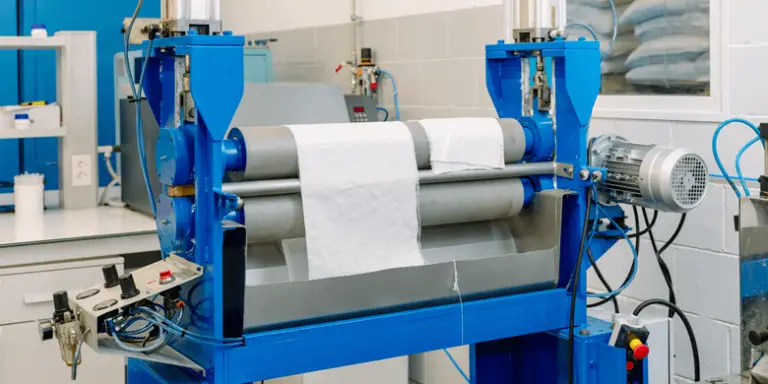
It is the most direct route when you work with flat or knit fabrics: you impregnate the textile in the bath and, later, you control the “pick-up” (%) when passing through the squeezing cylinders of the foulard. In production, performance comes through three levers: pick-up, concentration and drying/thermo-setting. To gain durability without stiffening the fabric, it is common to use water-based binders (e.g. water-based polyurethane ) and monitor the dispersion and foam of the bath.
Exhaust
When the fiber has an affinity with the chemistry (or you are looking for homogeneous penetration), the exhausted
It works very well: the fabric gradually absorbs the active ingredients from a bath, controlling pH, time, temperature and bath/fabric ratio. The key is to bring the system to balance without over-treating the substrate or affecting color or hand; In batch processes you will also see it described as batch dyeing.
Coating/laminate
If you need a more stable barrier or integrate multilayer functions, coating/laminate is the way: you apply a formulation (or adhere a membrane) to achieve specific performances — e.g. e.g., high UPF along with other functionalities. The technical base is well consolidated in the literature of coating and lamination in textile and in industrial manuals coated and laminated fabrics. In sustainability, it is advisable to prioritize water-based resins/binders and validate adhesion, flexibility and breathability after curing.
Recipe keys (what you should not lose sight of)
-
Compatibility with dyes and softeners to avoid migrations or loss of fastness.
-
Choice of binder (better if it is water-based polyurethane by balance between flexibility and strength) and cure adjustment.
-
Fine dispersion and foam control: improves uniformity and avoids “stuck” touches.
-
If they coexist with repellents without PFAS, avoid interference and line crossings: guide and MRSL of
-
ZDHC for PFAS and MRSL 3.0; As a practical plant reference, see Inditex PFAS-free guide.
Variables that determine the UPF
Fabric: density, weave and weight
The UPF does not depend only on the finish: the construction of the fabric is decisive. More compact structures (higher density/weight, closed ligaments) transmit less UV. The guides of ARPANSA / SunSmart and Hohenstein agree: tightening the weave and optimizing the weave usually improves protection, even before adding chemistry.
Material color
Dark shades absorb more UV radiation than light shades, which is why they usually have a higher UPF. If you need light colors, the anti-UV finish helps compensate. Practical recommendation: validate the target color with a UPF test, because the formulation and tone can interact.
Moisture and stretch
A wet or stretched fabric opens its structure and reduces UPF. If the final use involves sweat, frequent washing or stress (sports, outdoor), it is advisable to measure under representative conditions. Public agencies explicitly collect it (see ARPANSA and BfS – Germany ).
Number of washes and actual use
Durability is key: UPF should be measured before and after controlled washing and, if applicable, after sweating/rubbing. The reference methods define how to do it: AATCC TM183 (USA) and EN 13758-1/-2 (EU). If the commercial objective is, for example, UPF 40+ after X washes, specify that criterion from the briefing to align formulation and process.
Quick implementation tip
When combining light, light fabric with high UPF, consider a mixed approach (organic absorbent + mineral blocker) and control pick-up and curing: it usually offers the best balance between hand, breathability and protection (see standards framework in Hohenstein ).
Testing, durability and labeling
How UPF is measured
To quantify protection, recognized UV transmission methods are used. In USA, AATCC TM183 allows you to measure dry or wet fabrics; in Europe, EN 13758-1 defines the procedure for fabrics in new condition (dry, not stretched). Both report the UPF (the higher, the better protection), and the method is chosen according to the market/client.
Test that the UPF is maintained (durability)
Before “going out into the field”, it is advisable to validate the UPF after washing, sweating and rubbing/abrasion, because these conditions open the structure or drag the finish. Common practice includes standardized pre-exposure cycles (e.g. ASTM D6544 ) and then measurement with AATCC TM183 or EN 13758-1. If the final use is sports/outdoor, add wet/stretch tests to have a realistic photo.
How to label and what to promise (without going overboard)
To communicate protection, the EN 13758-2 establishes classification and marking in the EU (e.g. requirements for UPF 40+ and UVA transmission limits). In the US, labeling of protective textiles is guided by ASTM D6603, while AATCC offers a decision guide to guide tests and claims. Good practices: declare realistic ranges (e.g., “UPF 40+ after X washes under method ___”), indicate care instructions, and avoid extrapolating results outside of the tested method.
Quick checklist for your technical sheet
-
Test method and condition: AATCC TM183 (dry/wet) or EN 13758-1 (dry).
-
Pre-exposure/used durability (e.g., cycled per ASTM D6544).
-
Required result: p. e.g., UPF 40+ after X washes and UVA criteria.
-
Labeled according to EN 13758-2 (EU) or ASTM D6603 (USA).
Sustainability and safety
Water-based formulations and “PFAS-free” lines
For functional finishes (including UV protection), prioritize water-based systems and PFAS-free alternatives. The ZDHC MRSL v3.0 covers the entire PFAS class and its specific guide explains how to select and verify compliant chemicals; a practical way is to work with certified entries OEKO-TEX® ECO PASSPORT (recognized by ZDHC).
Chemical safety and plant effluent management
In addition to the SDS and toxicological evaluation, it is advisable to align the operation with an environmental management system (e.g. ISO 14001 ) and with the control of discharges according to the ZDHC Wastewater Guidelines
(sampling, limits and reporting for wastewater and sludge). If your suppliers already use chemicals with ECO PASSPORT or equivalent, they facilitate input and compliance control.
Design for recycling (“design for the next life”)
When the end use allows it, consider easily removable finishes (soluble or “strippable”) or combinations that do not block mechanical/chemical recycling. The sector reference is in the circular design frames such as the The Jeans Redesign Guidelines of the Ellen MacArthur Foundation, which guide “use more, redo and reuse”, avoiding problematic chemicals and facilitating disassembly/recyclability.
Use cases
Sporty and outdoor
In running, cycling or mountaineering, the fabric works stretched and humid, conditions that reduce UPF. That is why it is advisable to start from compact structures and reinforce with a hybrid finish (absorbent + mineral) that maintains breathability and touch. Always validate wet/stretched UPF (e.g. AATCC TM183 ) and use classification references like AS/NZS 4399 (via ARPANSA) to guide claims.
Practical tip: if the color must be light, the anti-UV finish compensates for the lower absorption of the tone. Check after X washes to confirm durability.
Workwear
Robustness rules here: high UPF after intensive washing cycles and prolonged use. Systems with well-dispersed mineral blockers (TiO₂/ZnO) and a water-based binder with fine curing usually work very well. Set the goal as “UPF 40+ after X washes” and label accordingly. EN 13758-2 (marked in EU). To simulate service, many brands test industrial washing (e.g. ISO 15797 ).
Practical tip: controls abrasion and pilling; If the fabric opens, the UPF drops.
Children
Prioritize comfort and safety: water-based finishes, lines PFAS-free, soft hand and balanced perspiration. Communicate values in a family-friendly way (e.g. UPF 50+ ≈ blocks ~98% UV) and avoid confusing UPF with SPF. Informative references: Skin Cancer Foundation and technical guide AATCC/EN.
Practical tip: test seams and elastic areas (where the fabric stretches the most).
Home textiles (awnings, curtains)
Stability to light and climate matters here. If you are looking for a more stable barrier you can go for coating/laminate while maintaining the tone and fall. In addition to UPF, it measures light resistance (
ISO 105-B02 ) and accelerated weathering ( ISO 4892 ) to ensure that performance does not degrade quickly in the sun. Tip: If the fabric is light, a well-formulated mineral finish helps maintain the UPF without dyeing it darker.
Implementation checklist
-
Defines the target specification. Sets the level of protection and its durability: e.g. e.g., UPF 30/40/50+ after X washes under AATCC TM183 either EN 13758-1/-2 depending on your market. That will guide all the formulation and testing.
-
Choose the compatible chemistry and binder. Select organic absorbent, mineral blocker (TiO₂/ZnO) or hybrid approach depending on fabric and shade; Combines with water-based binder (e.g., polyurethane) for balance between hand and wash resistance. Verify that everything complies ZDHC MRSL v3.0.
-
Adjust pick-up and curing, and validate in pilot. Optimizes concentration and pick-up in foulard, and defines drying/thermo-setting. In exhaust, it controls pH, time and temperature. Do pilot runs to check uniformity, hand and color before scaling.
-
Test durability and feature compatibility. Repeat the UPF measurement after washing, sweating and rubbing/abrasion (you can use pre-exposure type ASTM D6544 and then measure with AATCC/EN). Check that the anti-UV does not interfere with softening, PFAS-free repellencies, etc.
-
Document parameters and standardize in production. Write down recipe, pick-up, curing, test method and acceptance criteria (e.g., UPF 40+ after 20 washes). This facilitates replicability and customer audits.
Conclusion
Anti-UV finishes are a direct way to increase the protection and useful life of the textile. With proper formulation, rigorous UPF validation, and a sustainability approach (water-based, PFAS-free, design for recycling), it is possible to achieve high levels of protection while maintaining feel and breathability in real use.
Explore our solutions at textile finishing chemistry and discover how we can help you scale your project.